Enhance Your STEM Week: The Physics and Science Behind Circus Tricks
Circus tricks are a hands-on, visual way to demonstrate core physics concepts during STEM week — juggling illustrates Newton's laws of motion, spinning plates demonstrate centripetal force, and the diabolo is a perfect model of angular momentum in action. Elevate Circus Workshops can deliver a live circus skills session to your school that brings these principles to life in a way no textbook can.
When planning your school’s annual STEM (Science, Technology, Engineering, and Maths) Week, the challenge is always the same: how do you take complex scientific principles and make them feel real, active, and exciting for primary school children?
Find out more about our circus workshops for schools.
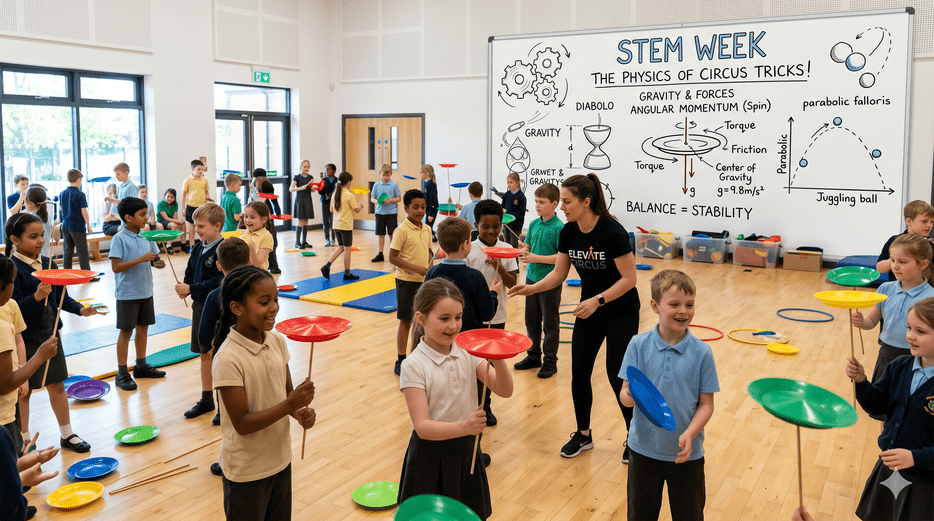
While textbooks and classroom experiments have their place, nothing captures a young imagination quite like the laws of physics in motion. At Elevate Circus Workshops, we love breaking down the barriers between physical activity and academic learning. It turns out that circus performers aren't just artists—they are masters of applied physics.
By bringing a circus skills workshop into your STEM Week, you can transform abstract concepts like gravity, torque, friction, and angular momentum into a hands-on, unforgettable science lesson. Here is how circus tricks bring the primary science curriculum to life.
The Gravity of Juggling: Freefall and Parabolic Arcs
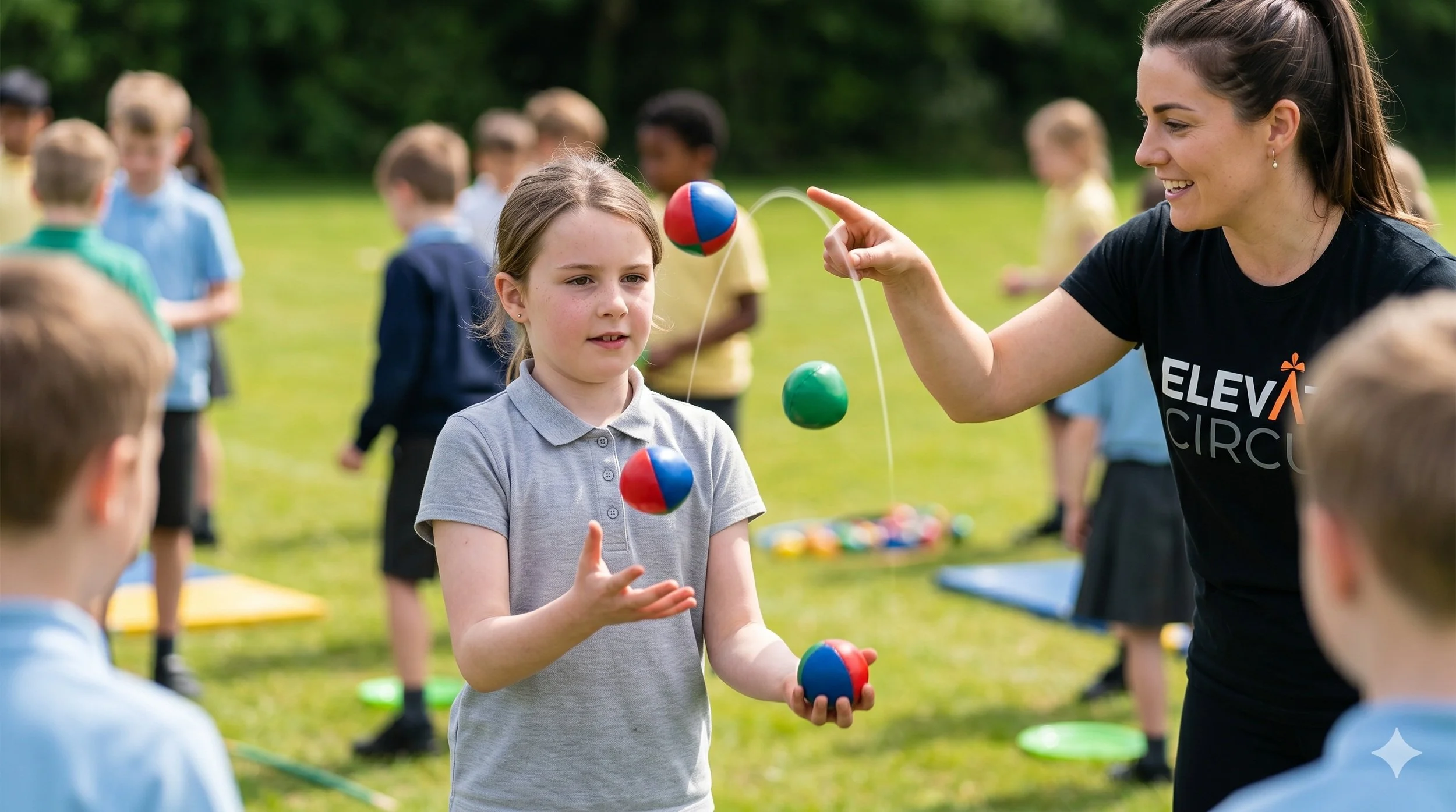
When a child throws a juggling ball or scarf into the air, they aren't just playing; they are experimenting with gravitational pull and trajectory.
Every thrown object follows a path known as a parabolic arc. To successfully catch and throw balls in a 3-ball cascade, a juggler has to subconsciously calculate the precise time it takes for gravity to pull the ball back down to Earth (acceleration due to gravity). By slowing down the action using lightweight juggling scarves, younger KS1 pupils can visually track the apex of the throw, making the invisible force of gravity completely tangible.
Spinning Plates and the Magic of Gyroscopic Stability
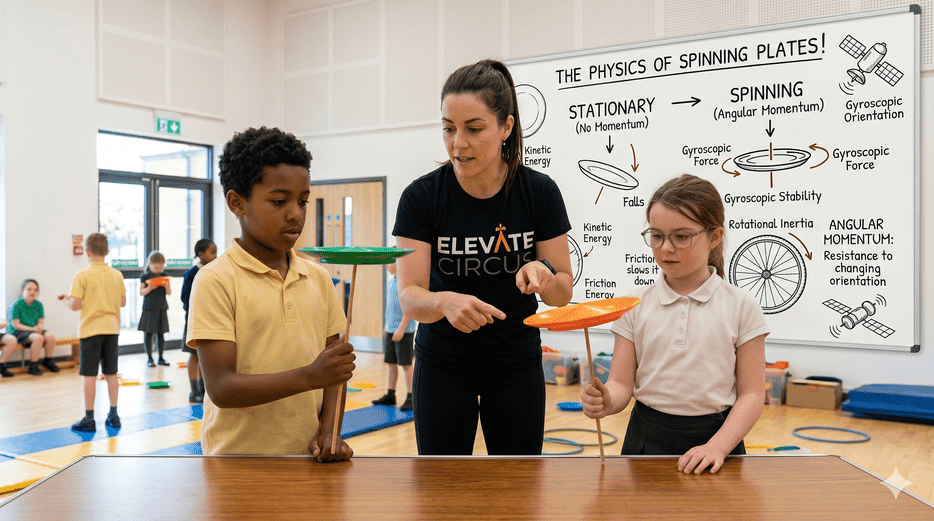
Why does a plastic plate fall off a stick when it’s stationary, but perfectly balances when it's spinning? The answer lies in angular momentum and gyroscopic stability.
When a plate spins, the distribution of its mass spinning around a central axis creates a force that resists changing its orientation. This is the exact same physics principle that keeps a bicycle upright when moving or a space satellite oriented correctly in orbit. In our workshops, pupils learn how to generate enough kinetic energy to start the spin and explore how the force of friction between the stick and the plate eventually slows it down, causing it to wobble. It is a perfect, interactive introduction to forces and motion.
The Diabolo: Rotational Inertia and Centre of Mass
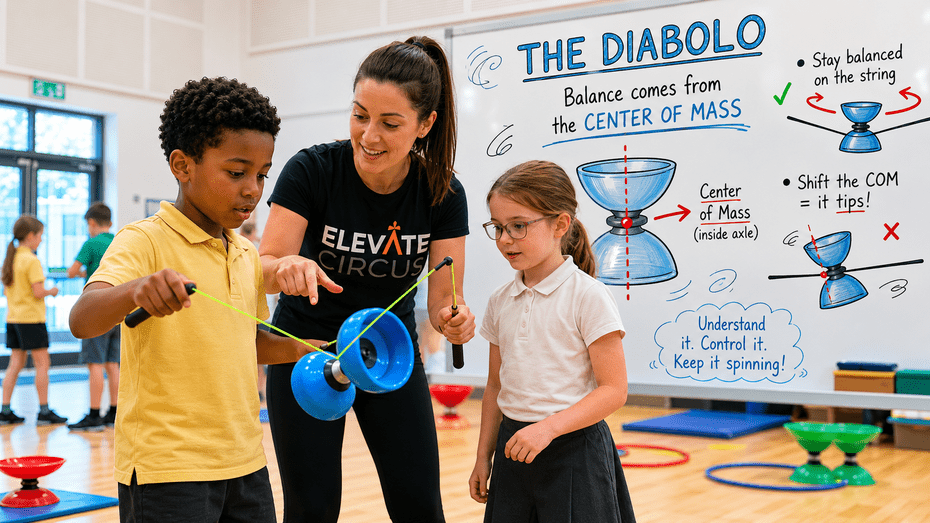
The diabolo is a massive favourite in schools, and it also happens to be a fantastic physics machine. Getting a diabolo to stay balanced on a string requires an understanding of its center of mass.
As pupils pull the string to make the diabolo spin rapidly, they are experiencing rotational inertia. The faster it spins, the more stable it becomes. Pupils can experiment with changing the tension of the string or adding friction to see how it alters the object's speed and balance. It bridges the gap between mechanical engineering concepts and physical coordination.
Turn Your School Hall into a Live Science Lab
Integrating circus arts into your STEM curriculum shows children that science isn't just restricted to lab coats and worksheets—it is alive in the way we move, play, and perform.
Want to supercharge your next school STEM Week or science day? Elevate Circus Workshops offers fully inclusive, educational, and energetic sessions tailored to all primary year groups across the UK.
👉 Get in touch today to check our availability! or email us on info@circusworkshops.co.uk to discuss how we can customize a workshop to match your specific science curriculum goals.
FAQs
Q: How do circus skills tie into STEM learning?
Circus tricks are packed with real physics — momentum, angular velocity, centre of gravity and force are all at play in juggling, spinning plates and balancing, making a workshop a hands-on way to demonstrate scientific principles rather than just describing them.
Q: What specific science concepts can be explored?
Depending on the activity, sessions can touch on momentum and timing (juggling), rotational force and gyroscopic stability (diabolo and plate spinning), and centre of gravity and balance (stilts and unicycling).
Q: Is this suitable as part of a dedicated STEM week?
Yes — it works well as a practical, memorable centrepiece for STEM week, giving pupils a physical demonstration of concepts they can then unpack in the classroom.
Q: Do you provide the science explanations, or just the physical activity?
Instructors can frame the session with the relevant physics as they teach each skill; how deeply this is unpacked can be tailored to your STEM week's classroom follow-up.
Q: What age groups is this suitable for?
Primary-aged children across the full range, with the science framing and activity complexity adjusted to suit the year group.
Q: What skills are used to demonstrate these principles?
Sessions draw from juggling, diabolo, plate spinning, poi, hula hoop, flower sticks, Chinese ribbons and balance skills, chosen to suit which scientific concepts you want to highlight.
Q: How much space and time do we need?
Roughly a tennis-court-sized indoor space as a minimum; session length is flexible depending on how much of your STEM week you want dedicated to it.
Q: Can this link to specific curriculum science topics, like forces?
Yes — sessions can be framed around relevant topics such as forces and motion, helping reinforce what's being taught elsewhere in your STEM week.
Q: How do we book a STEM-focused circus session?
Get in touch with your school, STEM week dates, year groups and any specific science topics you'd like the session to reinforce, and we'll tailor accordingly.
Related reading
Creative Cross-Curriculum Ideas: Using Circus Arts in the Classroom
How Circus Workshops Can Bring Key Primary Curriculum Books to Life
Using Circus Skills to Support Physical Literacy in Primary Schools
Book a circus skills workshop
Prices start from £225 — see how our pricing works. Get a quote for your school and we'll come back with a quote.
We deliver across mainland UK, including Norwich, London, Birmingham, Manchester and Leeds.
